


On the island of Lopud, in the Church of St. Mary of Šunj, there is a crucifix on the side altar of the Holy Cross, roughly life-sized and measuring 1.70 meters in height, about which, until a few years ago, we knew very little. It had been only briefly mentioned in the literature.
It was approximately dated to the 17th century, and the only information we had was that, in the early 1990s, it had been unprofessionally repainted with marine paint. It is common for wooden sculptures, which often suffer damage in damp church environments, to be repainted in an effort to preserve them.
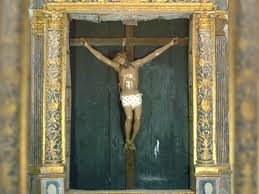
The Mexican Crucifix On The Island Of Lopud
Since the churches of Lopud house important examples of woodcarving art — primarily from the late Renaissance, i.e., the late 16th and first half of the 17th century — an international project was launched to research and conserve these significant artworks. As the Lopud crucifix was believed to belong to this rich corpus preserved on the island, the decision was made to remove it from the altar for conservation, during which it was discovered that the crucifix was surprisingly light.
Because it took only one person to remove the crucifix, the question arose: why was it so light? For a wooden sculpture made of solid wood — even of the lightest material — one would expect it to have a certain weight. The first assumption was rather pessimistic: it was thought that woodworms and other insects had eaten away most of the sculpture’s interior. To either confirm or disprove this theory, the crucifix was taken to Dubrovnik Hospital and subjected to a CT scan, just like a human patient would be. The result was more than surprising.
It turned out that the crucifix was hollow inside and that the interior was not made of wood as expected, but of corn stalks. This was quite an astonishing discovery, raising questions about the type of craftsmanship involved. It turned out to be a complete rarity within the known corpus of crucifixes and sculptures from that era on the eastern Adriatic coast. Further phytochemical analysis determined that the material was Mexican maize. This finding was highly surprising for all of us who study our historical heritage and required the involvement of foreign experts specializing in similar artifacts to properly contextualize the Lopud crucifix.
To that end, experts from Spain and Mexico, specializing in sculptures made of maize stalks, were invited. In post-Christianization Mexico, artisans used traditional techniques known from the pre-Columbian period to create new Christian objects. This was an ancient technique revived for making Christian religious items. Researchers identified several production centers — one in Puebla, central Mexico, and another in Mexico City. Notably, a crucifix found in the Cathedral of Puebla matched the Lopud crucifix almost perfectly in stylistic characteristics. Therefore, the Lopud crucifix can be linked to that Mexican workshop from the second half of the 16th century.
For the expert and interested public, this was a major discovery, raising the next important question: how did the crucifix reach Lopud, and when? Research into this is still ongoing. It’s important to note that Lopud’s tradition is deeply tied to seafaring, and there were several prominent captains and sailors in the 16th and 17th centuries who sailed to both Spain and Mexico. It is very likely that the crucifix arrived on our shores through their mediation.
So far, two individuals — Miho Pracat and Vice Bune — are considered potential commissioners of the crucifix. Historical documents link them to the Spanish Crown; they served under King Philip II and King Philip III. Although no definitive evidence exists yet, it is highly likely that one of them was responsible for this extraordinary commission. This discovery shows that other crucifixes — about which little is known — could also conceal similarly astonishing histories. The journeys of our crucifixes were far broader and more complex than we could have imagined.